How AI Helps Me Stay Professional in Online Sales (Without Losing My Mind)

Selling things online sounds easy, but anyone who’s done it seriously knows the reality: it’s a lot of tiny decisions, photo taking, descriptive writing, and odd messages. Some buyers are great. Some aren’t. Most of the headaches happen in the messaging, not the sale itself.

Over time, I’ve gotten better at handling this. One reason? I’ve been using AI to help me think through how I communicate in these situations.

Why bother?

Because writing clear, polite, professional responses over and over takes more energy than it should. And if you’re like me, someone who wants to be clear, fair, and firm but not rude, it helps to have a second brain that isn’t tired, annoyed, or in a rush.

AI doesn’t replace your judgment. It helps you slow down, think it through, and find the right words. That’s where it shines.

What It Helps Me Do

Here’s where AI has been practically useful in my online sales:

  • Clarity: When a potential buyer sends a vague or pushy message, AI helps me write responses that are professional, clear, and polite,  without opening doors I don’t want to open (like haggling in DMs).
  • Boundaries: I can quickly write and refine messages that set expectations clearly, without sounding defensive.
  • Efficiency: I keep a few AI-generated templates ready to tweak for common questions. It saves me time and makes my tone consistent.

Why This Matters

How you communicate online shapes how people treat you. Clear, polite, professional responses deter time-wasters and reassure serious buyers. AI makes it easier to keep your standards high, even when you’re tired or frustrated.

Not Magic, Just Practical

I’m skeptical by nature. I don’t think AI is going to change human nature or solve every problem. But used the right way, it’s a tool that helps you think, write, and communicate more clearly. That’s valuable, especially when small interactions add up to your reputation, your time, and your sanity.

If you’re in sales, communication, or customer-facing work of any kind, this is where AI actually earns its keep. Not by writing marketing hype. Not by pretending to be you. But by helping you show up consistently as your most professional, clear-headed self.


Disclaimer: I used the LLM GPt-4o to generate a draft of this post and to perform some of the tasks described.  Ultimately I wrote most of this post and made the final edits. It’s based on my concepts and ideas.

1950s Inspired S-Style Partscaster Guitar with a Fat Neck

I hope there will be many more posts like this. Over the past several years guitars and amplifiers have become a big part of my life and they bring me a lot of joy. 

The main goal of this guitar build was to have a Stratocaster for slide using my favorite neck. I have a real hate love relationship with this guitar shape. I grew up annoyed with their ubiquity thanks to Eric Clapton. Ironic I suppose because his signature neck is supposedly a soft V… You’ll see why in a bit.

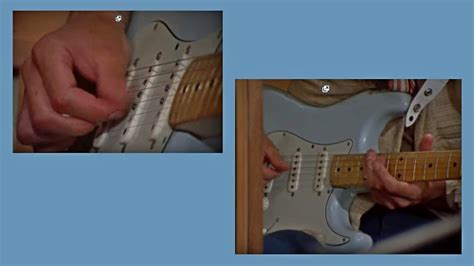
Screenshot closeups from Youtube Video of Harrison playing on Lennon Song

I really love George Harrison’s slide solos. They sing with the most beautiful voice. This was my sonic motivation that led me on a deep dive for the known specifications on his Stratocasters. This guitar is inspired by them, not an attempt at a replica. In short his are ‘60s guitars. And mine is more 50’s style, like the neck.

It started with the Fender Ed O’Brien Stratocater I got. I fell in love with how it’s neck feels in my hand. It’s called the Fender EOB, 10/56 “V”. Guess you could call it a soft V shape. For years I thought about buying another. Just didn’t want to dissemble my EOB Stratocaster just to start over. The Fender manual specifications say its profile height is .895” at the first fret and 1” high at the 12th fret. The fret board has a common 9.5” radius. It’s made entirely of maple, both the neck and fretboard, with medium nickel frets, truss rod adjusted at the heel, and old style tuners.

Without realizing it I duplicated the colors from my modified EOB Strat. White body, black pickguard, maple neck, off white knobs, & silver hardware. This is my current favorite guitar color pallet. Is there another famous guitar of this style? Not sure what inspired my color choices.

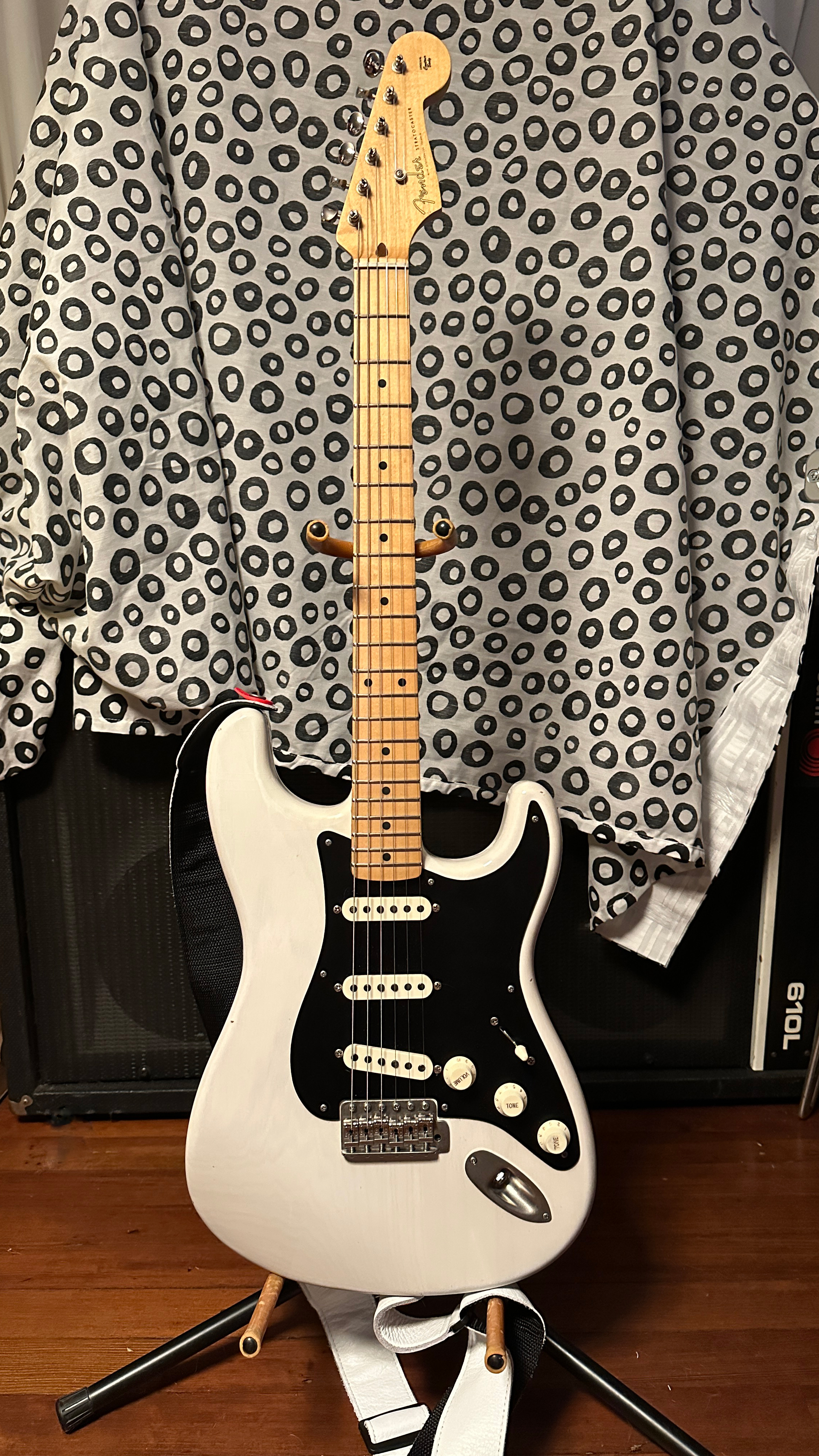
S-Style partscaster in a 1950's style setup for slide guitar playing
My S-style partscaster. Based on 1950’s tech and a fat neck.

Here are the main parts and the builders who made them.

The body is by BloomDoom Guitars. It’s swamp ash and has a thin aged blonde white nitrocellulose finish.

The neck is by Fender. (See above.) Apparently it’s not liked by some as they regularly come up for sale. Bonus for me! May need another. Really! I dream of an aluminum neck with this kind of profile.

The loaded pickguard was built by Brandonwound. The pickups are 50’s style and low output. It’s a historically accurate 8 hole guard with a distressed old look. Sounds amazing. All five positions have real character. Yes, I know Fender didn’t use black pickguards on Strats till the ‘70s.

The hardware is from Callaham Guitars and is made in the Commonwealth of Virginia, USA. It’s vintage Strat style that came with a tremolo bridge, jack, neck plate, saddles, strap buttons, etc. I ordered the hardware distressed and it looks great. Didn’t end up using their tuners on this guitar. Maybe the next build. (Thinking about a HSS strat.)

Right now the strap I’m using is a cheap white leather one from Levis. I had no idea it would feel so great.

Major thanks to Alex at Cosmic Sea Guitar Repair for assembling and setting up this guitar. His advice and support over the past few years has been amazing.

Brian Russell’s History with the Early Days of Podcasting

I started podcasting in 2004 after learning about it from Adam Curry’s show Daily Source Code. I also read David Winer’s blog (10/26/2005) at the time.

It began with Ruby Sinreich giving me an early iPod for my birthday. I thought, “What can I MAKE to put on this thing?”

The answer to my own question was the Audio Activism podcast in 2004. Here is an old version of the Audio Activism website (October 4, 2004). This is my very first podcast from October 3, 2004. The show was called “3 URLs” and it was my take on important and fun website content. Part review and part “Check this cool stuff out!”. HUGE thanks to ibiblio.org for hosting lots of my work over the years!

In 2005 I began organizing the world’s first self organized conference focused on teaching people how to podcast. It was called PodcasterCon and was held on Saturday, January 7, 2006, at the University of North Carolina – Chapel Hill. Over 200 people attended. Half came to Chapel Hill from outside of the state of North Carolina. Big thanks to Paul Jones for his help. Many others assisted. Here are some photos from PodcasterCon 2006. This is a movie someone else made that includes me opening up the event to a crowd of people.

Here are a few newspaper articles that describe my work at the time.
Podcasting takes off – News & Observer, The (Raleigh, NC) – March 22, 2005
Radio cast in a new light – News & Observer, The (Raleigh, NC) – January 8, 2006

This is one newspaper article I wrote that was published in print.
DIY radio – Or how I learned to stop worrying about the media and start podcasting, (Wayback Machine archive link), December 18, 2005

When time allows I’ll add more info about my work and all the fun I had then.