
(via Plustek OpticFilm 7400 Scanner 60-A1A-BBM310-C B&H Photo Video)
I hear this scanner is good at scanning b&w negatives.
Art & Photography
(via Plustek OpticFilm 7400 Scanner 60-A1A-BBM310-C B&H Photo Video)
I hear this scanner is good at scanning b&w negatives.

Portrait of Charles Goodman, date unknown. Photograph by Mosher, Charles Delevan.
I’m fond of this pic for how its framed. Maybe it was cropped in the darkroom this way. Portraits done with a square ratio, such as 6×6 from 120 medium format film, are nice. But this provides a little bit more information. Hmmm.
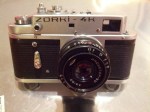
Zorki 4k with Industar 50mm 3.5 lens. Just came in the mail. Shooting test roll now.
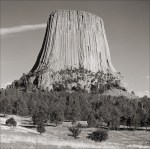
Devil’s Tower Tele-Rolleiflex IlfordHP5+ HC-110dilH 9min 18C 1minAg1x 2012-06 VSmac 9000 Scan-121110-0002 (by rich8155 (Richard Sintchak))
Great shot. Amazing natural wonder.
A Cooperative of Photographers – Artists, Scientists, Historians –
Dedicated to the Renaissance of Handcrafted Silver Gelatin Emulsions An Evolving Body of Knowledge

Mobile Darkroom
Silver halides are used in photographic film and photographic paper, including graphic art film and paper, where silver halide crystals in gelatin are coated on to a film base, glass or paper substrate.
The purpose of coating on a lens is to reduce reflections from the lens’ surface.

Last night I watched Fellini’s movie 8 1/2. Some how after a ton of art school and old film obsession I had never seen it. Besides the amazing dream sequences what really struck me was the silver color of the black and white film. Amazing!
So this morning I googled “silver black and white 8 1/2” and stumbled upon this conversation over at the Analog Film Users Group (APUG) titled Black and White film with tones more silver than grey. Lots of stupid responses from people who don’t understand the thread owners question and probably haven’t seen the film.
But I think the answer to why and how there is so much silver in 8 1/2 has to do with every element of film photography. Light, lens, film stock, development, cinematography, etc. A more technical answer lies in the descriptions of Holden Richards 8×10 photography on Flickr. I will be investigating more because this silver is EXACTLY how I dream my still photos will appear.
The history of the Kardon camera is a story of forgotten American genius. The Kardon camera, manufactured in several variations from 1945-‘54 represents an important American contribution to the then-state-of-the-art “miniature” camera. And it represents Peter Kardon’s patriotic effort to answer to the US military’s need for a high-quality 35mm camera during World War II. The Kardon camera was a technical success, and a financial failure, whose last remnants now, after 60 years, reside in my camera shop.
 Brian C. Russell