Ok. I said it. I’m writing a book. I’ve avoided saying that out loud or writing it here because I have lots of book ideas. But rarely have they made it this far. This idea has a lot of blood, sweat, time, and ideas behind it. It’s really a result of the past four years of doing business.
Now I am about start a new chapter in my career. I’ve spent the past three years working in a office environment I created from the ground up. It coincided with my first experience being a entrepreneur. Something I had dreamt about for decades but avoided.
Some of the blog posts that follow will be a debriefing about what I’ve learned. Primarily about creating highly productive work environments. It involves interior design, community building, the changing nature of work and play, how to save money when building a office, the element of time, and the truth that less really is more.
This is first outline for Work Different (A working title).
Introduction
Work & Play is merging in the modern office
Build Community
Physical: Events inside and outside of work time
Virtual: Pair programming, Not just for computer scientists
Save money
using existing cheap office space
use cheap furniture
Free On-line Services like Google Docs, Gmail, Hangout, etc
Less is More
Smaller offices are best
cheaper
less energy
less waste
Help save planet
The element of time is critical
when work is done determines what kind of space is needed
quiet time
phone calls
conference calls
meetings
head down working at the computer
Tiny Disclaimer: This future book is an important piece of professional writing for me. I plan on profiting from it. A confident statement I realize. But just so you know I can’t promise your contributions will be compensated for monetarily. But I will thank you loudly.
All that said I need your help. This is my first book. I’m dyslexic, a bad speller, and have notoriously bad grammar skills. So as I write chapters and pieces of chapters please provide feedback, correct spelling, suggest new directions, or what ever you think is necessary. Try to be kind. 🙂
Coworking
1. The act of working together to get things done.
2. A global movement of coworkers and coworking spaces.
3. Offices that provided a consistent location for independent workers to be productive.
I’m elaborating on it here rather than using someone else’s definition for a few reasons. One is that I founded and ran a Coworking space for three years and have some strong opinions on the subject. Another is my definition greatly informs my writing on how people can work together well and be very productive doing it. This is a foundation for future writing. So when you see the word coworking I mean this definition. I will link to it for reference and context.
BTW – the word Coworking doesn’t have a hyphen between co and working. At least that’s how people spell it who are part of the Coworking movement.
My first real job was doing digital print design for a book. It was a eighty page art book with ten pages of full color photography of painting. I had used Apple computers all through college to edit QuickTime movies that became part of video installation art. Then someone asked me if I knew how to use them. As in “Do you know how to use this computer thingy?”. They didn’t ask if I’d done a book design before. Just had I used a Apple computer. I said yes.
This job took me out of the studio using mechanical tools and paint brushes and thrust me into the office. I spent that entire summer in-front of a computer slinging digital files. Previously I had sworn I would never work in a office. I went to get a Fine Arts degree because I felt I did not have the skills and temperament to work “in business”. That skepticism mixed with creativity forced me on a path to reinvent the office environment.
Since that first job I’ve worked in lots of offices. From the nine to five to visiting clients and working at home. I cultivated a career as a ‘tech guy’. Someone who is known to use the left side of their brain. But I had been born with a strong right side and trained to use it.
For those who learned I had a Fine Arts degree it was very confusing. Why would a “artist” be working in a office and know about computers? Because the stereotype of the socially inept and uncreative computer nerd had sunk in peoples’ minds. This stereotype would soon be turned on its head by a new generation who used digital tools to create. And it happened that those tools, computers, like to be operated in a air-conditioned office.
I’ll admit a certain amount of internal pressure to please my parents. They were very skeptical about my desire to go to art school. My mother reminded me what a bad idea it was all through college and long after. So in some sort of response I sought after and obtained jobs at businesses. In part to prove I could do it. For as a child I had learned that I could do anything if I wanted to.
Now I am about start a new chapter in my career. I’ve spent the past three years working in a office environment I created from the ground up. It coincided with my first experience being a entrepreneur. Something I had dreamt about for decades but avoided.
Some of the blog posts that follow will be a debriefing about what I’ve learned. Primarily about creating highly productive work environments. It involves interior design, community building, the changing nature of work and play, how to save money when building a office, the element of time, and the truth that less really is more.
So check back as I get all this info out of my skull. Please forgive my horrendous grammar, poor spelling, and dyslexic word flipping. This is just a sketchbook for now. Maybe one day this will become a proper book.
The ultimate weakness of violence is that it is a descending spiral, begetting the very thing it seeks to destroy. Instead of diminishing evil, it multiplies it. Through violence you may murder the liar, but you cannot murder the lie, nor establish the truth. Through violence you may murder the hater, but you do not murder hate. In fact, violence merely increases hate. So it goes. … Returning hate for hate multiplies hate, adding deeper darkness to a night already devoid of stars. Darkness cannot drive out darkness: only light can do that. Hate cannot drive out hate: only love can do that.
I was just honored by our local AM radio station WCHL 1360 with the Village Pride Award. A pretty cool thing to receive. Here is the mp3 of their mini peice about me. Thanks to WCHL, Ruby, and Ron Stutts WCHL Village Pride Award – Brian Russell
A little context: WCHL is our hyper local news and Tar Heel sports station. If you live in Chapel Hill and Carrboro for any length of time you’ll start listening. Especially to Woody Durham, “Voice of the Tar Heels“, during Tar Heel basketball season.
Illustration from original D&D manual. Boing Boing contributor and awesome author Cory Doctorow points us to WTF, D&D!? post called The Original Dungeons & Dragons. It has scans of a lot of the original art I’ve been looking at. Cool stuff plus the childish commentary is pretty funny… sometimes. 🙂
Hex, the board game All this thinking about games, in-between doing real work, I’ve run across some abstract strategy games. A friend gave me a copy of Go a few years ago. Only played it once or twice. But this game Hex has me intrigued ….
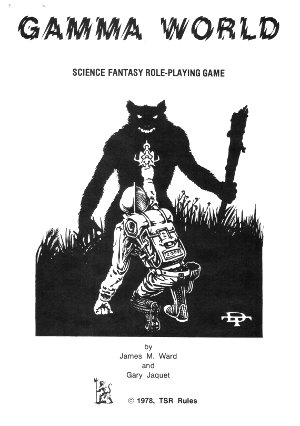
My first day at the Duke Special Collections Library I looked through three boxes. Each one had about four game boxes in them. The first one, Box #9, had three box sets from the RPG Gamma World by TSR Games. The first box I opened was Gamma World 3002 circa 1978 by James M. Ward & Gary Jaquet. This is a early paper based roll playing game set in a post-apocalyptic world after a nuclear war that combines fantasy and science fiction characters.
I totally recognized this game. Not sure if I ever played it but I’m sure I either spent hours looking at it in a game shop or at a friends house. The forward of the rules book acknowledges influences from science fiction books and the Ralph Bakshi movie Wizards [Link to the whole movie on YouTube!]. Its interesting evidence that nothing in the arts is completely new. But a re-imagining of the world around us.
Gamma World Manual inside Cover
The art on the inside cover page of the Gamma World Manual from 1978 is of a guy in a wearing some kind of fatigues crouched down pointing a ray gun at a large humanoid creature with cat/bear ears holding a large club. Its a black and white ink drawing that imitates a wood block cut. The signature is the letter D and T on-top of one another. These initials are similar to the signature of Albrecht Dürer. While this illustration is not nearly the same level of detail as a wood block its very interesting to get a glimpse of this artists inspiration from the signature.
Gamma World Basic Rules Booklet
The second game box I opened was the Gamma World 7010 Basic Rules Booklet circa 1986 from TSR, Inc.. It has a full color cover with large pseudo three dimensional title letters. Beneath the main title is a sub title that reads, “Science Fantasy Role-Playing Game”. It’s a good reminder of the mash-up of two different creative genres.
The illustration on the cover is of a man who looks like a roman soilder holding a large laser gun riding a white horse. Is he the good guy? The solider is charging two humanoid creatures on the ground who appear to be defending themselves. The creature on the left has pointy ears and is wearing a furry loin cloth. He’s firing a large laser bazooka at the guy on the horse. Fortunately for the rider the bazooka blast misses him. Another fellow leans back holding a shield in one hand and a laser pistol in another. He has on a helmet with silver hoses coming out the back that end at a utility belt. He is also wearing fetching green tights and big boots with fur on top. His skin is like armor. This amazing illustration is by Keith Parkinson. His signature adorns the lower right corner of the work.
When I see this cover I feel a combination of nostalgia and distain. The style is super cheesy yet totally constant with the time and genre of art used for fantasy and science fiction games. I’ve personally enjoyed more dark science fiction art like the kind imagined for Aliens by H.R. Geiger. Somehow its sinisterness makes it more real.
My university professor, Elizabeth King, told us that artist receive inspiration from two creative sources, fantasy and science fiction. Then and now I believe that most of my creativity spawns from Sci-fi. But I read all the J.R.R. Tolkien books in middle and high school & love nature. Did that not stick? I guess when I started making art with computers I became a technology Utopian. I believe that humans can improve themselves with creativity and engineering. Recently that belief has been shaken.
Artists don’t have to be influenced by only fantasy or only science fiction. Issac Newton worked hard to prove that the magic of alchemy can be explained by laws of science. In a way role playing games are creative live action research to prove this very assertion. Here is what the Gamma World Basic Rules Booklet says we need to get started with this research.
Pg. 2-3
Part I: INTRODUCTION
What You Need to Play
In order to play a GAMMA WORLD game, you need the following:
* This Rule Book
* The Adventure Book
* The dice provided in this game
* Pencils and erasers
* Paper and graph paper
For your first adventure, you should play the one enclosed in this game set. It has been designed so that it can be played without a GM. Or it may be used by one player to help him Game Mater a group of other players.
The contents of this game set include the following:
* The rule Book with attached appendices
* The introductory Adventure Book
* The Game Master’s Screen with all the most important tables
* The Reference Book with important tables and appendices, as well as a campaign setting for use in creating your own adventures
* The Player’s Screen with tables
* The large four-color map of a ruined city, the countryside, and a map of America.
* Sets of six and 10-sided dice
Gamma World Rule Book
The final game in box #9 was Gamma World Rule Book circa 1983. Its book cover has a similar design to the Basic Rules Booklet. The main title was 3D but didn’t have the extruded Y axis. A border of similar color and luminance goes around the top, right, and left sides. Inside the border is a illustration of a futuristic knight in high tech armor holding a large bazooka sized gun. He rides upon a giant cat like steed with two rows of very sharp teeth and claws. A armor of similar style covers the mounts head, feet, back, and tail. This giant cat appears to be a cyborg of some kind with hoses connected to its head that has a helmet that covers its eyes and doesn’t appear to come off. Both of these figures stand atop a very big rock. In the background is a big sky and the snow covered mountains of a very large mountain range.
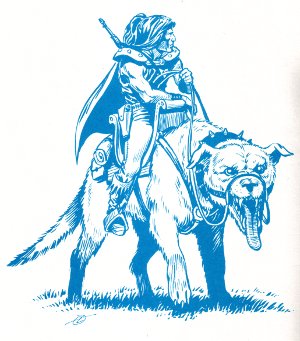
Gamma World Basic Rules Booklet Inside Cover Art
The inside cover of the Gamma World Rule Book has a blue spot color illustration that appears to be a offset print. A guy with long dark hair wearing a cape with no shirt and tight pants rocks boots with a scalloped material on top. A futuristic rifle is slung across his chest and pokes out from behind his back. The dude sits atop a very large dog in a mid or far eastern style saddle. The choice, by the artist, not to illustrate a western saddle gives it a other worldly look in context with the other items. The rabid looking steed bares his teeth and lets his tongue hang out till it almost touches the ground. A spiked collar and a muzzle complete the giant dogs attire.
Next post in this series is about the RPG I found in Box #19.
Note: This work is pretend scholarly research and inspired by morbid curiosity. I intend to respect the intellectual property of all companies and persons. If you object to your images being on this page please contact me and I’ll take them down asap.




 Brian C. Russell